· Hamza · Programming · 3 min read
React vs Vue: Which JavaScript Framework Should You Learn in 2026?
Compare React and Vue in terms of performance, learning curve, ecosystem, job opportunities, and real-world use cases to choose the best framework.
React vs Vue: Which JavaScript Framework Should You Learn in 2026?
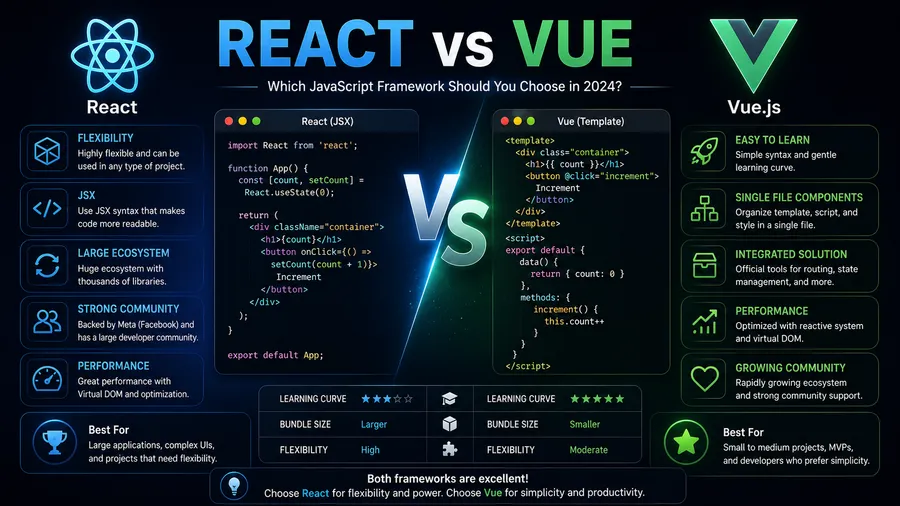
React and Vue are two of the most popular technologies for building modern web applications. Both allow developers to create fast, interactive, and scalable user interfaces, but they differ in philosophy, ecosystem, and learning experience.
In this guide, we’ll compare React and Vue to help you decide which one best fits your goals.
What Is React?
React is an open-source JavaScript library developed by Meta (formerly Facebook) for building user interfaces.
It is widely used for:
- Single Page Applications (SPAs)
- Large-scale web applications
- Mobile apps with React Native
- Interactive dashboards
- Enterprise software
React powers many of the world’s most popular websites and applications.
What Is Vue?
Vue is an open-source JavaScript framework created by Evan You.
It focuses on simplicity, flexibility, and developer experience.
Vue is commonly used for:
- Web applications
- Dashboards
- Progressive Web Apps (PWAs)
- Small and medium-sized projects
- Enterprise applications
Vue is especially popular among developers looking for a gentle learning curve.
Learning Curve
React
React requires learning several concepts:
- JSX
- Components
- Hooks
- State management
- Routing
- Build tools
Although React is beginner-friendly, mastering its ecosystem takes time.
Vue
Vue is often considered easier to learn because it provides:
- Familiar HTML templates
- Simple syntax
- Clear documentation
- Built-in features
For many beginners, Vue feels more approachable.
Performance
Both frameworks offer excellent performance.
React
Advantages:
- Virtual DOM
- Efficient rendering
- Excellent scalability
- Large optimization ecosystem
Vue
Advantages:
- Lightweight
- Fast rendering
- Efficient reactivity system
- Small bundle size
In most real-world applications, performance differences are minimal.
Syntax Comparison
React
function App() {
  return <h1>Hello World</h1>;
}
Vue
<template>
  <h1>Hello World</h1>
</template>
Vue’s template syntax is closer to standard HTML, while React uses JSX.
Ecosystem
React
Popular tools include:
- Next.js
- React Router
- Redux
- React Query
- React Native
Vue
Popular tools include:
- Nuxt
- Vue Router
- Pinia
- Vuex
- Vite
Both ecosystems are mature and well supported.
Community
React has one of the largest developer communities in the world.
Benefits include:
- Massive documentation
- Thousands of tutorials
- Large open-source ecosystem
- Extensive third-party libraries
Vue also has a strong and growing community with excellent documentation and active contributors.
Job Opportunities
React currently offers more job opportunities worldwide.
Typical React roles include:
- Frontend Developer
- Full-Stack Developer
- React Native Developer
- UI Engineer
Vue jobs are also growing steadily, especially among startups and companies that prefer its simplicity.
Advantages of React
- Huge community
- Strong job market
- Large ecosystem
- Excellent scalability
- React Native for mobile apps
- Backed by Meta
Advantages of Vue
- Easier to learn
- Clean syntax
- Lightweight
- Excellent documentation
- Built-in features
- Fast development experience
Disadvantages of React
- Steeper learning curve
- Frequent ecosystem changes
- Requires choosing additional libraries for routing and state management
Disadvantages of Vue
- Smaller job market than React
- Smaller ecosystem
- Fewer enterprise projects globally
When Should You Choose React?
React is a great choice if you want to:
- Become a professional frontend developer
- Build large applications
- Work in enterprise environments
- Develop mobile apps with React Native
- Access a larger job market
When Should You Choose Vue?
Vue is ideal if you want to:
- Learn frontend development quickly
- Build small or medium-sized applications
- Create dashboards
- Develop prototypes rapidly
- Enjoy a simpler developer experience
Frequently Asked Questions
Is Vue easier than React?
Yes. Most beginners find Vue easier because of its familiar HTML-like syntax and straightforward documentation.
Is React faster than Vue?
Both are highly optimized. In most real-world projects, users are unlikely to notice a significant performance difference.
Which framework has more jobs?
React currently has a larger global job market, making it a popular choice for developers seeking employment.
Can I learn both?
Yes. Learning one framework makes it much easier to learn the other since both are based on modern JavaScript concepts.
Which framework should beginners learn in 2026?
If your goal is maximizing career opportunities, React is often the better choice. If you prefer a smoother learning experience and faster onboarding, Vue is an excellent option.
Conclusion
React and Vue are both outstanding tools for building modern web applications. React offers a larger ecosystem, stronger job demand, and excellent scalability, while Vue provides a cleaner syntax and an easier learning experience.
The best choice depends on your goals. If you’re aiming for enterprise development or a broad job market, React is a strong investment. If you want to learn quickly and build applications with minimal complexity, Vue is an excellent alternative.