· Hamza · Programming · 4 min read
Learn JavaScript for Beginners: A Complete Guide (2026)
Learn JavaScript from scratch. Understand variables, functions, loops, arrays, objects, DOM manipulation, events, and modern JavaScript fundamentals.
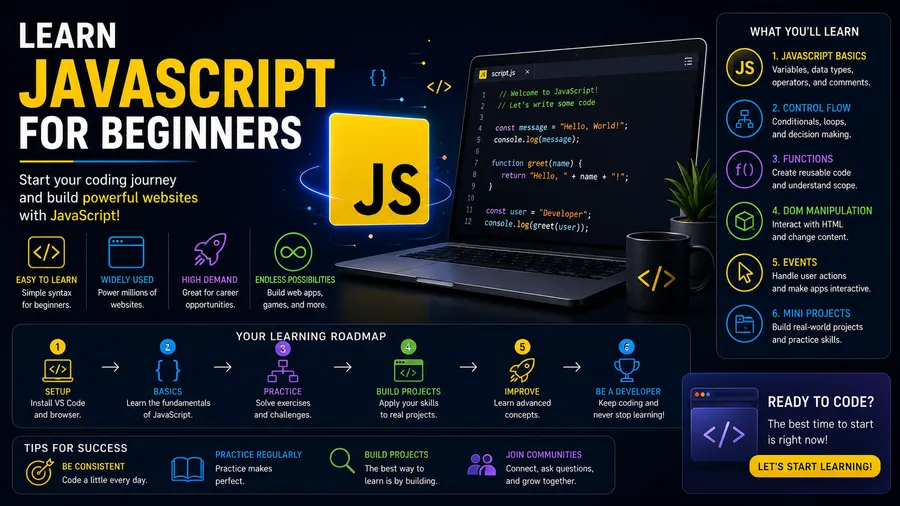
Learn JavaScript for Beginners: A Complete Guide (2026)
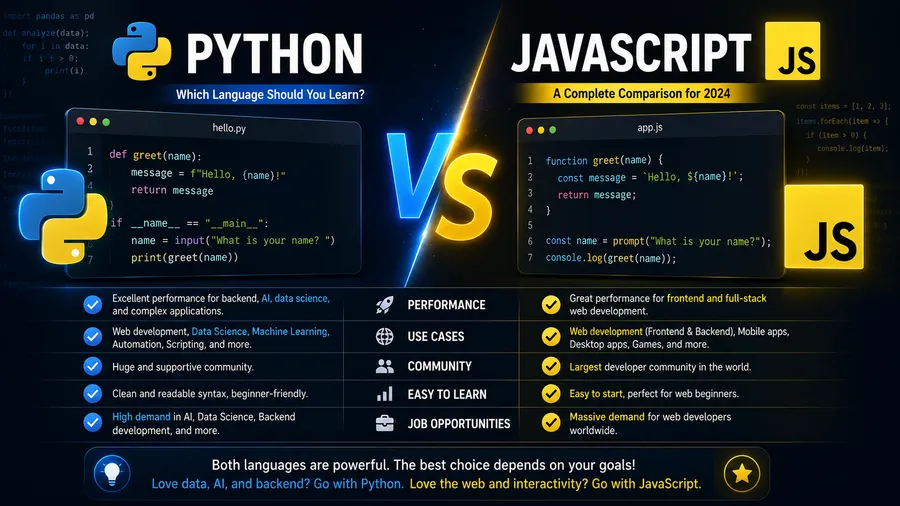
JavaScript is one of the most popular programming languages in the world. It powers interactive websites, web applications, mobile apps, servers, and even desktop software.
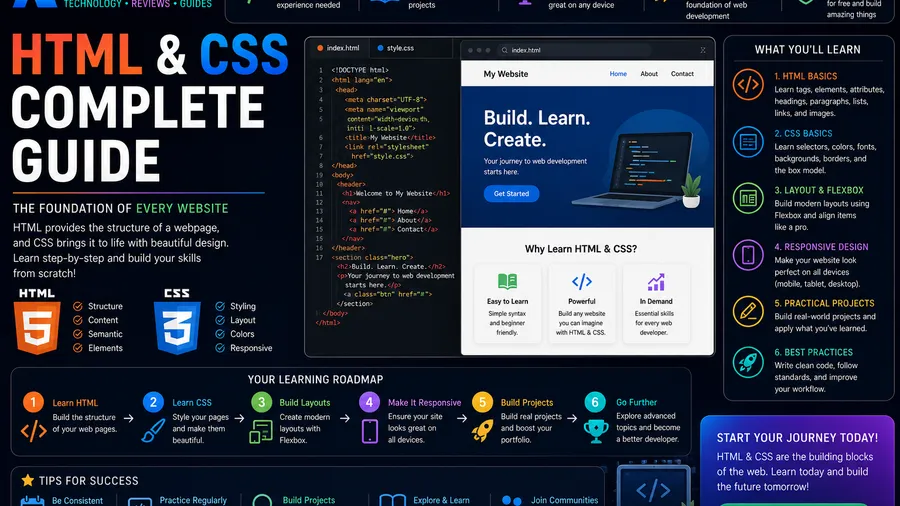
If you’re learning web development, JavaScript is the next step after HTML and CSS. In this guide, you’ll learn the fundamentals of JavaScript and build a strong foundation for modern web development.
What Is JavaScript?
JavaScript is a programming language that adds functionality and interactivity to websites.
With JavaScript, you can:
- Create dynamic web pages
- Build interactive forms
- Update page content without reloading
- Validate user input
- Create animations
- Build games
- Develop web applications
Today, JavaScript is used on millions of websites worldwide.
Why Learn JavaScript?
JavaScript is valuable because it allows developers to:
- Build interactive websites
- Create full-stack applications
- Develop mobile apps
- Build desktop software
- Work with modern frameworks
- Access a large job market
It is one of the most in-demand programming skills.
Adding JavaScript to a Website
You can include JavaScript using the <script> tag.
Example:
<script>
console.log("Hello World");
</script>
Or link an external JavaScript file:
<script src="script.js"></script>Using external files keeps your code organized and easier to maintain.
Variables
Variables store data.
Example:
let name = "Hamza";
const age = 22;letis used for values that can change.constis used for values that remain constant.
Using meaningful variable names makes code easier to understand.
Data Types
JavaScript supports several data types.
Examples:
let text = "Hello";
let number = 100;
let price = 19.99;
let isOnline = true;
let user = null;
Common data types include:
- String
- Number
- Boolean
- Null
- Undefined
- Object
- Array
Operators
JavaScript includes arithmetic operators such as:
let result = 10 + 5;Comparison operators:
10 > 5
10 === 10
Logical operators:
&&
||
!
Operators allow your programs to make calculations and decisions.
Conditional Statements
Conditions allow your program to make decisions.
Example:
let age = 20;

if (age >= 18) {
    console.log("Adult");
} else {
    console.log("Minor");
}
Conditional statements are essential in almost every application.
Loops
Loops repeat code automatically.
Example:
for (let i = 1; i <= 5; i++) {
    console.log(i);
}
Common loop types include:
- for
- while
- do…while
- for…of
- for…in
Loops help automate repetitive tasks.
Functions
Functions group reusable code.
Example:
function greet(name) {
    return "Hello " + name;
}

console.log(greet("Hamza"));
Functions improve code organization and readability.
Arrays
Arrays store multiple values.
Example:
let fruits = ["Apple", "Banana", "Orange"];Access items:
console.log(fruits[0]);Arrays are widely used to manage collections of data.
Objects
Objects store related information.
Example:
let person = {
    name: "Hamza",
    age: 22,
    country: "Morocco"
};

console.log(person.name);
Objects are fundamental to JavaScript programming.
DOM Manipulation
The Document Object Model (DOM) allows JavaScript to modify web pages.
Example:
document.getElementById("title").textContent = "Welcome!";JavaScript can:
- Change text
- Update images
- Modify styles
- Add or remove elements
- Respond to user actions
Events
JavaScript responds to user interactions through events.
Example:
button.addEventListener("click", function () {
    alert("Button clicked!");
});
Common events include:
- click
- submit
- input
- keydown
- mouseover
Events make websites interactive.
JavaScript ES6 Features
Modern JavaScript introduced powerful new features.
Examples include:
- Arrow functions
- Template literals
- Destructuring
- Modules
- Classes
- Spread operator
- Optional chaining
Learning ES6 makes your code cleaner and more efficient.
Best Practices
To write better JavaScript:
- Use meaningful variable names.
- Keep functions small.
- Write clean, readable code.
- Comment only when necessary.
- Reuse code whenever possible.
- Test your programs regularly.
- Follow consistent formatting.
Good habits improve maintainability and collaboration.
Common Beginner Mistakes
Avoid these common errors:
- Forgetting semicolons where required by your style guide
- Using
varinstead ofletorconst - Ignoring error messages
- Writing very long functions
- Repeating code unnecessarily
- Not testing your code
Learning from mistakes is part of becoming a better developer.
What Should You Learn Next?
After mastering JavaScript basics, consider learning:
- Git & GitHub
- DOM Projects
- Asynchronous JavaScript
- APIs
- TypeScript
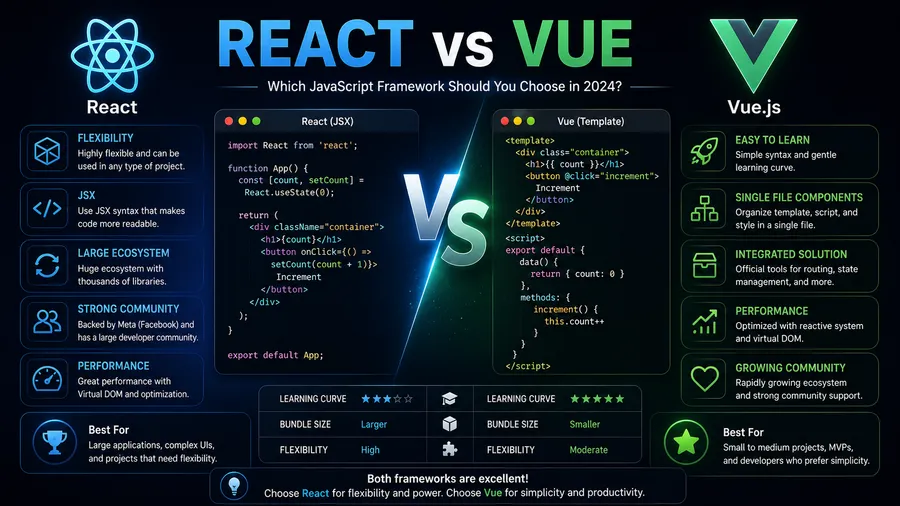
- React
- Next.js
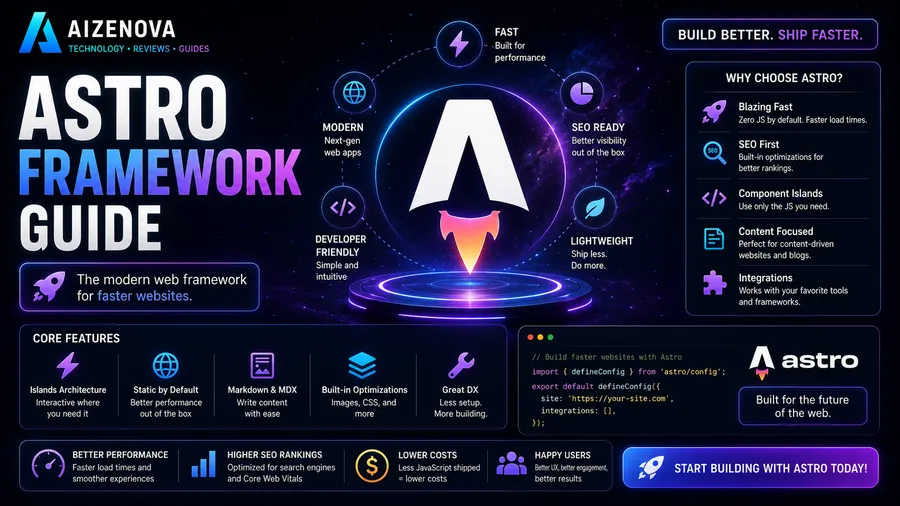
- Astro
- Node.js
These technologies build on your JavaScript knowledge.
Frequently Asked Questions
Is JavaScript difficult to learn?
No. JavaScript is beginner-friendly, although mastering advanced concepts takes time and practice.
Do I need HTML and CSS first?
Yes. Understanding HTML and CSS makes learning JavaScript much easier because JavaScript interacts directly with web pages.
Can JavaScript build complete websites?
Yes. Combined with HTML and CSS, JavaScript can power complete websites and web applications.
Is JavaScript still worth learning in 2026?
Absolutely. JavaScript remains one of the most widely used programming languages and is essential for modern web development.
How long does it take to learn JavaScript?
Most beginners can learn the fundamentals within a few weeks of consistent practice. Becoming proficient typically requires building real projects over several months.
Conclusion
JavaScript is an essential programming language for anyone interested in web development. It transforms static web pages into interactive applications and serves as the foundation for many modern frameworks and technologies.
By mastering variables, functions, loops, objects, arrays, and DOM manipulation, you’ll be well prepared to build real-world projects and continue your journey toward becoming a professional web developer.