· Hamza · Programming · 4 min read
What Is an API? A Complete Beginner's Guide (2026)
Learn what an API is, how APIs work, the different types of APIs, real-world examples, and why APIs are essential in modern software development.
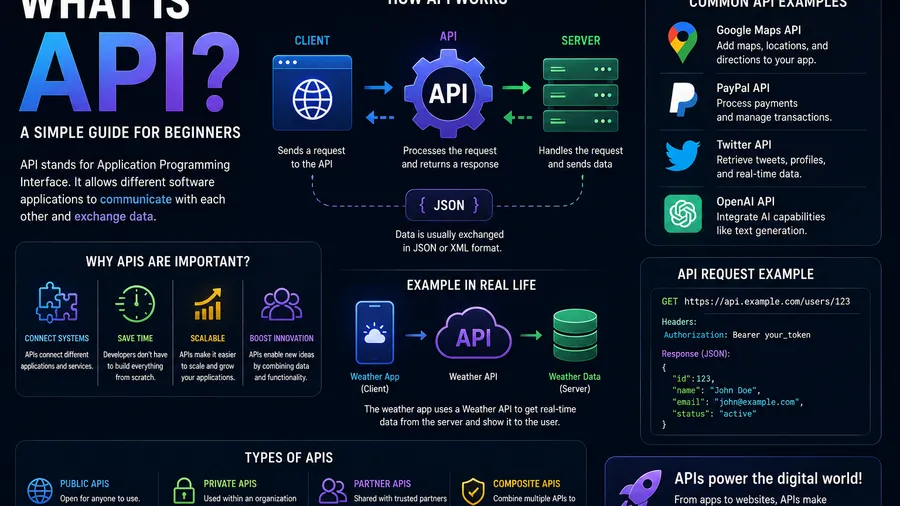
What Is an API? A Complete Beginner’s Guide (2026)
APIs are the backbone of modern software development. Every time you check the weather on your phone, log in with Google, or make an online payment, an API is likely working behind the scenes.
In this guide, you’ll learn what an API is, how it works, the different types of APIs, and why developers use them every day.
What Is an API?
API stands for Application Programming Interface.
An API is a set of rules that allows two different software applications to communicate with each other.
Instead of building every feature from scratch, developers use APIs to request information or services from another application.
Think of an API as a messenger that delivers requests and responses between different systems.
How Does an API Work?
The API process is simple:
- A user performs an action.
- The application sends a request to an API.
- The API forwards the request to a server.
- The server processes the request.
- The API returns the response.
- The application displays the result.
This communication usually happens within seconds.
Real-World Example
Imagine you’re using a weather app.
When you open the app:
- The app sends a request to a weather API.
- The API retrieves the latest weather data.
- The server responds with the forecast.
- The app displays the information on your screen.
Without the API, the weather app couldn’t access real-time weather data.
Why Are APIs Important?
APIs make software development faster and more efficient.
Benefits include:
- Easy integration between applications
- Faster development
- Code reusability
- Improved scalability
- Better automation
- Access to third-party services
Today, nearly every modern application relies on APIs.
Common Types of APIs
There are several types of APIs.
Public APIs
Available for anyone to use.
Examples:
- OpenWeather API
- GitHub API
- NASA API
Private APIs
Used internally within an organization.
These APIs connect internal systems and services.
Partner APIs
Shared only with approved business partners.
They often require authentication and agreements.
REST APIs
REST (Representational State Transfer) is the most popular API architecture.
REST APIs use standard HTTP methods such as:
- GET
- POST
- PUT
- DELETE
Most web applications today use REST APIs.
HTTP Methods
GET
Retrieve information.
Example:
GET /usersPOST
Create new data.
Example:
POST /usersPUT
Update existing information.
Example:
PUT /users/15DELETE
Remove data.
Example:
DELETE /users/15These methods form the foundation of REST APIs.
API Requests and Responses
Most APIs exchange data using JSON.
Example request:
GET https://api.example.com/usersExample response:
{
  "id": 1,
  "name": "Hamza",
  "country": "Morocco"
}
JSON is lightweight, easy to read, and supported by most programming languages.
API Authentication
Many APIs require authentication to protect data.
Common authentication methods include:
- API Keys
- OAuth 2.0
- Bearer Tokens
- JWT (JSON Web Tokens)
Authentication ensures that only authorized users and applications can access protected resources.
Popular APIs
Some widely used APIs include:
- Google Maps API
- OpenAI API
- GitHub API
- Stripe API
- PayPal API
- X (Twitter) API
- YouTube Data API
- Spotify API
These APIs allow developers to integrate powerful features without building them from scratch.
Advantages of APIs
APIs offer many benefits:
- Faster application development
- Easier software integration
- Better scalability
- Reduced development costs
- Improved user experience
- Access to external services
They enable developers to focus on building unique features instead of reinventing existing solutions.
Challenges of APIs
While APIs are powerful, they also have limitations:
- Rate limits
- Authentication complexity
- Network dependency
- Version changes
- Security concerns
- Downtime of external services
Proper planning and error handling help minimize these issues.
Who Uses APIs?
APIs are used by:
- Web developers
- Mobile app developers
- Software engineers
- AI developers
- E-commerce platforms
- Financial institutions
- Social media platforms
- Cloud service providers
Virtually every modern software company uses APIs.
Frequently Asked Questions
What does API stand for?
API stands for Application Programming Interface.
Why are APIs important?
APIs allow different software systems to communicate, making it easier to build applications, integrate services, and automate tasks.
What is a REST API?
A REST API is a type of web API that uses HTTP methods such as GET, POST, PUT, and DELETE to exchange data between applications.
What format do APIs use?
Most modern APIs use JSON because it is lightweight, easy to read, and supported by nearly every programming language.
Should beginners learn APIs?
Absolutely. Understanding APIs is an essential skill for web developers, mobile developers, backend engineers, and anyone interested in modern software development.
Conclusion
APIs are one of the most important technologies in modern software development. They enable applications to communicate, share data, and access powerful services quickly and efficiently.
Whether you’re building websites, mobile apps, AI tools, or cloud applications, understanding how APIs work will help you create more capable and connected software. Learning the basics of requests, responses, authentication, and REST principles is an excellent foundation for any aspiring developer.